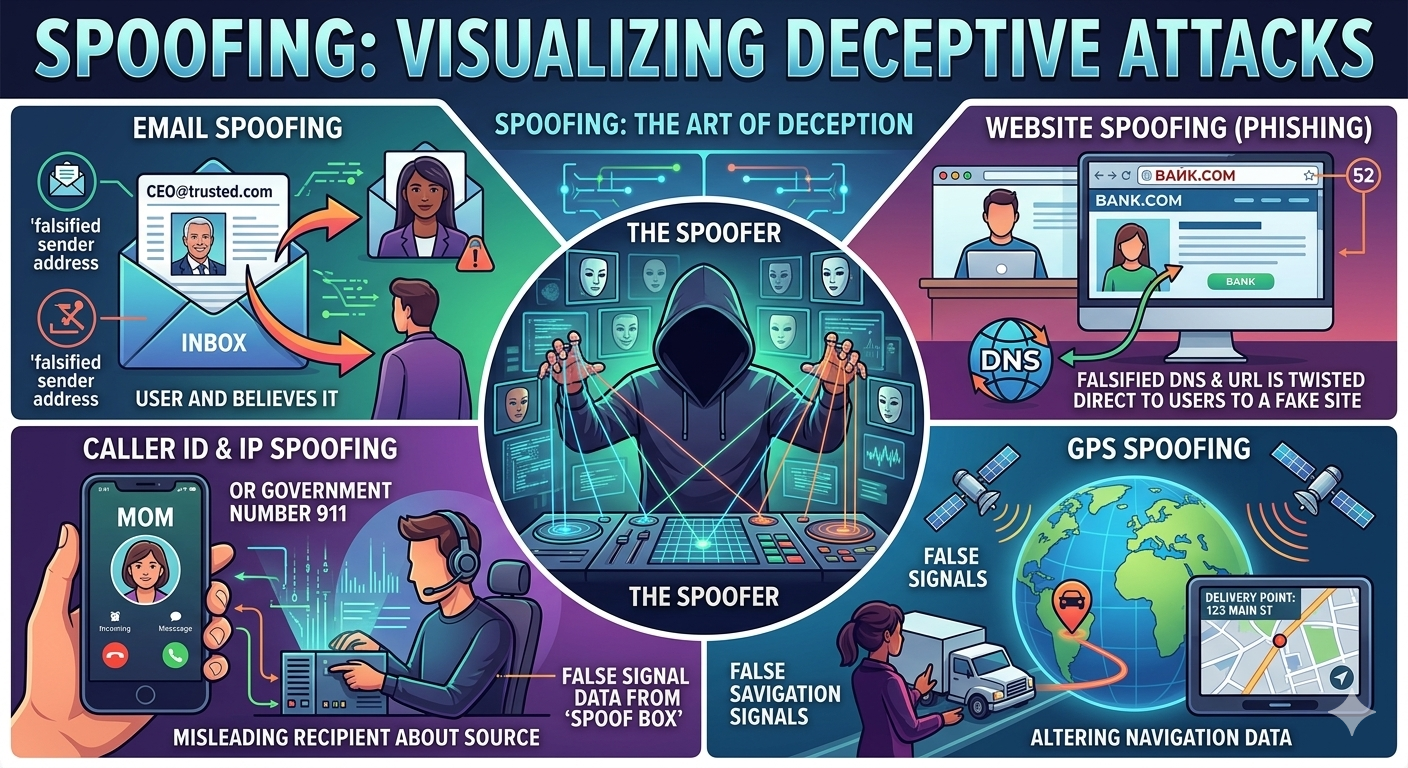
Understanding how attackers disguise their identity to trick systems and users.
Spoofing is a type of cyberattack where an attacker disguises their identity, or the origin of data, to deceive systems or users. By impersonating a legitimate entity, attackers can bypass security controls, gain unauthorized access, or deliver malicious payloads. This guide will explore various spoofing techniques, common tools, and essential countermeasures.
How Spoofing Works
Spoofing attacks exploit the trust inherent in network protocols and human perception. Attackers manipulate information to appear as if it originates from a trusted source.
The core principle is impersonation:
Identity Disguise: Changing source IP address, MAC address, email sender, or phone number.
Data Manipulation: Altering DNS records or routing information to redirect traffic.
Trust Exploitation: Leveraging the fact that systems and users often don't rigorously verify the true origin of communications.
Deception: Spoofing is fundamentally about tricking a target into believing something is authentic when it is not.
Types of Spoofing Attacks
Spoofing manifests in various forms across different layers of the network stack:
1. IP Spoofing
Creating IP packets with a false source IP address to hide the attacker's identity or impersonate another system. Often used in Denial-of-Service (DoS) attacks.
# Conceptual example of sending a spoofed packet (requires raw socket access)
# scapy example (Python library for packet manipulation)
# send(IP(src="192.168.1.100", dst="target.com")/ICMP())
2. MAC Spoofing
Changing a device's MAC (Media Access Control) address to bypass MAC-based filters or impersonate another device on a local network.
# Change MAC address (Linux)
ifconfig eth0 down
ifconfig eth0 hw ether 00:11:22:33:44:55
ifconfig eth0 up
3. ARP Spoofing (ARP Poisoning)
Sending forged ARP (Address Resolution Protocol) messages to link an attacker's MAC address with the IP address of a legitimate network device (e.g., default gateway or another host). This redirects traffic through the attacker's machine, enabling Man-in-the-Middle (MITM) attacks.
4. DNS Spoofing (DNS Cache Poisoning)
Injecting forged DNS records into a DNS resolver's cache, causing it to return an incorrect IP address for a domain. This redirects users to malicious websites.
5. Email Spoofing
Forging the sender's address of an email so that it appears to originate from someone other than the actual sender. Commonly used in phishing and spam campaigns.
6. Caller ID Spoofing
Manipulating the caller ID displayed on a recipient's phone to show a different number, often used in vishing (voice phishing) attacks.
Quick Question:
Which type of spoofing attack is commonly used to redirect network traffic through an attacker's machine for a Man-in-the-Middle attack?
Tools Used in Spoofing Attacks (for ethical purposes)
Ethical hackers use these tools to simulate spoofing attacks and test defenses:
1. Ettercap
A comprehensive suite for MITM attacks, including ARP spoofing, DNS spoofing, and packet sniffing.
# Start Ettercap in graphical mode
ettercap -G

# Perform ARP poisoning on a network segment
ettercap -T -Q -i eth0 -M arp:remote /target_ip/ /gateway_ip/
2. Arpspoof (part of dsniff suite)
A simple and effective tool for ARP spoofing.
# Redirect traffic from target to attacker (attacker's IP)
arpspoof -i eth0 -t <target_ip> <gateway_ip>

# Redirect traffic from gateway to attacker
arpspoof -i eth0 -t <gateway_ip> <target_ip>
3. Scapy
A powerful Python library for crafting, sending, sniffing, and dissecting network packets. Highly flexible for various spoofing scenarios.
A highly configurable DNS proxy for pentesters and malware analysts. Can be used for DNS spoofing.
# Start DNSChef to redirect example.com to a specific IP
dnschef.py --fakeip 1.2.3.4 --fakedomains example.com
Ethical Use: These tools are for authorized security assessments and educational purposes only. Unauthorized use is illegal and unethical.
Countermeasures Against Spoofing Attacks
Defending against spoofing requires a multi-layered approach across different network layers:
1. Network Security Controls
Dynamic ARP Inspection (DAI): On switches, validates ARP packets to prevent ARP spoofing by checking against DHCP snooping bindings.
IP Source Guard: Prevents IP spoofing by filtering traffic based on IP-MAC-port bindings.
Port Security: Limits the number of MAC addresses allowed on a switch port, mitigating MAC flooding and spoofing.
Antispoofing Filters (Ingress Filtering): Configure routers to block incoming packets with source IP addresses that do not belong to the originating network.
2. DNS Security
DNSSEC (DNS Security Extensions): Provides cryptographic authentication of DNS data, preventing DNS cache poisoning.
Secure DNS Resolvers: Use trusted DNS resolvers that implement DNSSEC.
3. Email Security
SPF (Sender Policy Framework): Authenticates email senders by verifying their IP address.
DMARC (Domain-based Message Authentication, Reporting & Conformance): Builds on SPF and DKIM to provide policies for handling unauthenticated emails.
Email Gateways & Filters: Advanced email security solutions to detect and block spoofed emails.
4. Encryption & Authentication
HTTPS/TLS: Encrypts web traffic, protecting against session hijacking even if DNS is spoofed.
Multi-Factor Authentication (MFA): Adds an extra layer of security, making it harder for attackers to log in even with spoofed credentials.
Holistic Approach: No single countermeasure is foolproof. A combination of technical controls and user awareness is essential.
Conclusion
Spoofing attacks leverage deception to bypass security mechanisms and achieve malicious goals. Understanding the various forms of spoofing and implementing robust defensive strategies are crucial for maintaining network and data integrity.
Key takeaways:
Spoofing is Impersonation: Disguising identity or data origin.
Diverse Techniques: IP, MAC, ARP, DNS, Email, Caller ID spoofing.
Tools Aid Simulation: Ettercap, Arpspoof, Scapy for ethical testing.
Layered Defense: Network controls, DNSSEC, email authentication, and encryption are vital.